Locksmith
Straight answers about locks
Before you pick up the phone
Can you get me in if my smart lock has died?
Yes, usually. Backup access on a keypad or app-controlled deadbolt depends on the model. Many carry small external terminals that wake the lock when a fresh nine-volt battery is touched to them, long enough to enter your code; some also keep a conventional keyed override behind a cover, which a locksmith can pick or decode like any other cylinder, while other current models have no cylinder at all and rely only on their own recovery method. Once inside, the batteries are replaced and your codes are checked.
We need to open for customers. How do you sequence the visit?
Entry comes first and repairs second. Once authority is confirmed the door is opened, staff go in and start their routine, and the locksmith turns to the cause: extracting a broken key, rekeying for a lost one, re-springing a deadlatch or lifting a dropped door. Anything that can wait for a quieter hour, such as rekeying interior doors, is offered as a return visit so the shop floor is not blocked while it trades.
What proof do I need to show?
Photo identification and something that connects you to the lock. For a house or apartment that is a lease, a bill, addressed post, or confirmation from the property manager; for a business, your role there; for a vehicle, the registration or ownership papers with matching identification. If the documents are inside, say so on the phone and the check is completed once the door is open.
Should I keep the broken lock and strike?
Yes, unless the insurer has already said they are not needed. Insurers generally ask policyholders to retain damaged property until the claim is settled, and a bag holding the twisted cylinder, torn strike and split wood answers an adjuster's questions more clearly than any description. The locksmith hands them over at the end of the visit along with a written note of what was replaced. Photographs of the parts in place, before removal, complete the record.
Should I spray something into the keyway while I wait?
Better not, unless it is a proper dry lock lubricant. Household oils, general penetrating sprays and hinge silicone thicken inside the cylinder and attract grit, so they buy a day and cost a service later. If the lock is frozen, a lock de-icer is fine; boiling water is not, since it refreezes deeper in. The most useful thing to do while waiting is to stop turning the key, so it does not bend or snap.
Should I rekey when I move into a new home?
Lock manufacturers list moving as one of the main reasons to rekey, and it is easy to see why: previous owners, their relatives, a cleaner, a dog walker and a contractor may all hold copies you know nothing about. Rekeying every exterior cylinder in one visit resets the count to the keys in your hand, and it is a convenient moment to put every door on a single key as well.
Will my door hardware look any different afterwards?
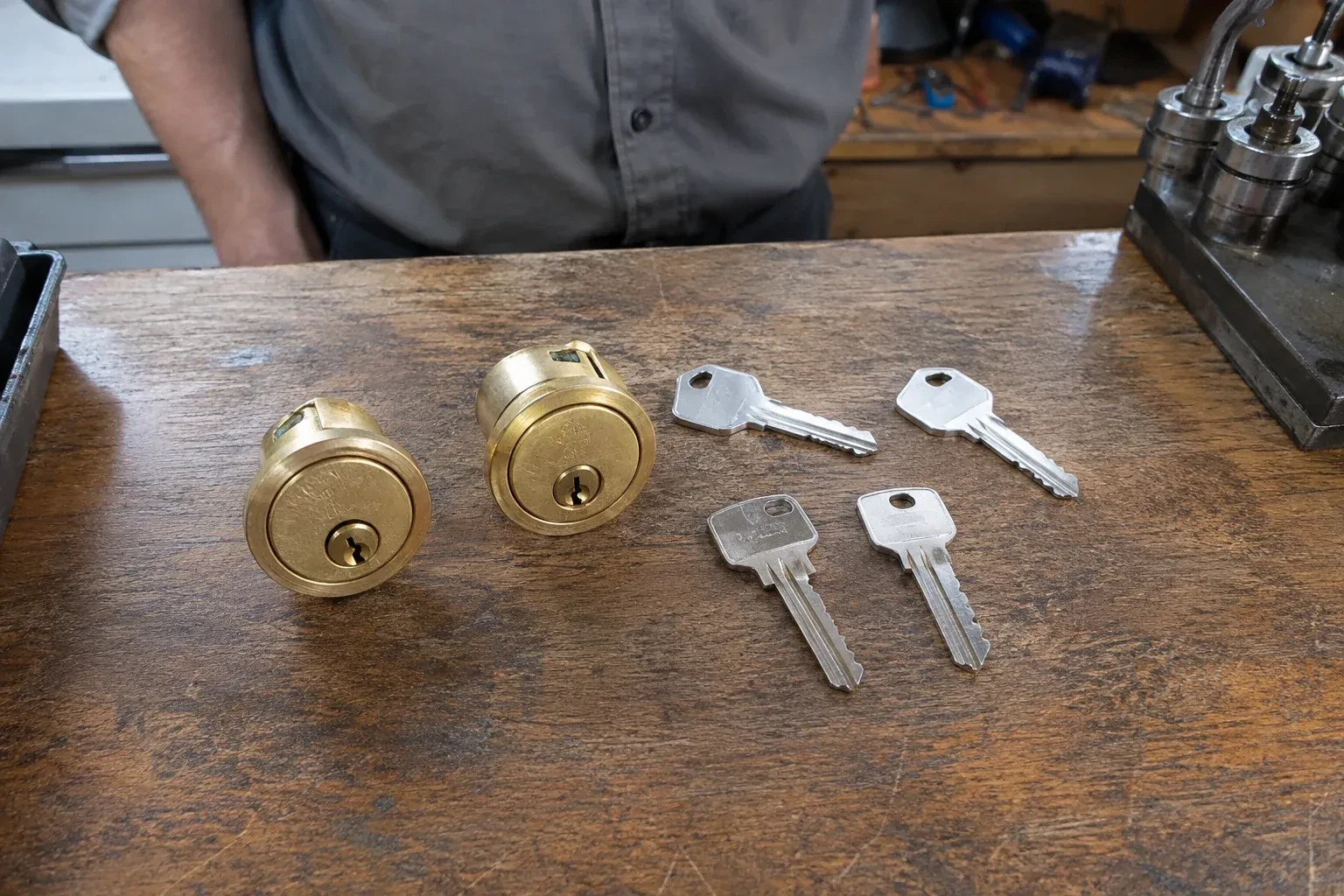
No. The work happens inside the cylinder, so the bolt, handle, finish and strike plate stay exactly as they are, and nothing new is cut into the door. The only visible change is the key in your hand. If a cylinder does have to be replaced, because its keyway is incompatible with the others or it has worn out, the locksmith picks one in a matching finish so the door keeps a consistent look.
Do I need a deadbolt on the door from the garage into the house?
It is worth having. The door between an attached garage and the living space is in practice often the softest way in, since a garage door left open leaves a passage knob as the only barrier. A thumb-turn deadbolt there costs a few minutes a day and closes that gap.
Can you replace the lock on a sliding patio door or French doors?
Yes. Sliding doors take a replacement mortise hook lock sized to the rail, often with a keyed exterior, and benefit from a secondary foot bolt or a pin through the frames. French doors are secured by treating the inactive leaf properly with flush bolts into the head and sill, then fitting a deadbolt to the active leaf with a strike into that reinforced edge. Both are routine parts of a residential upgrade.
Does a rented home need the landlord involved for this work?
Repairing a lock so it works as before is ordinary maintenance, but anything that changes who can open the door, such as a rekeyed cylinder or new keys, is something a tenant and landlord are expected to agree on and share keys for. The locksmith asks up front who should receive keys and can leave a note of what was done for the property manager, so both sides know what is on the door.
Will a smart lock fit my existing door?
Most residential doors have the standard preparation these locks are designed around: a large hole for the lock body, a smaller one in the edge for the bolt, and a thickness between roughly 35 and 45 millimetres. The locksmith measures all three plus the backset before recommending a model. Thicker doors take an extension kit, thin or glass-panelled doors and older doors with a mortise pocket call for a particular model or some preparation, and all of that is sorted out before the box is opened.
Can a gate that slams shut be fixed without replacing the whole closer?
Often, yes. A closer that slams is frequently just out of adjustment rather than worn out, and bringing its closing speed and final latching action back into a sensible range solves the problem on its own. Replacement becomes the answer when the arm, seals or internal fluid have genuinely failed, which the locksmith checks for directly rather than assuming from the symptom alone. Either way, the gate is tested through several full cycles before the visit is called finished.
Can I get a spare key cut for a family member later?
Yes, either during the same visit or afterward, as long as it is cut from the new cylinder's combination rather than copied from an already-worn key. Cutting it while the locksmith is present avoids a second stop at a hardware store and confirms the spare works before anyone relies on it.
Can several employees each get their own code once the safe is open?
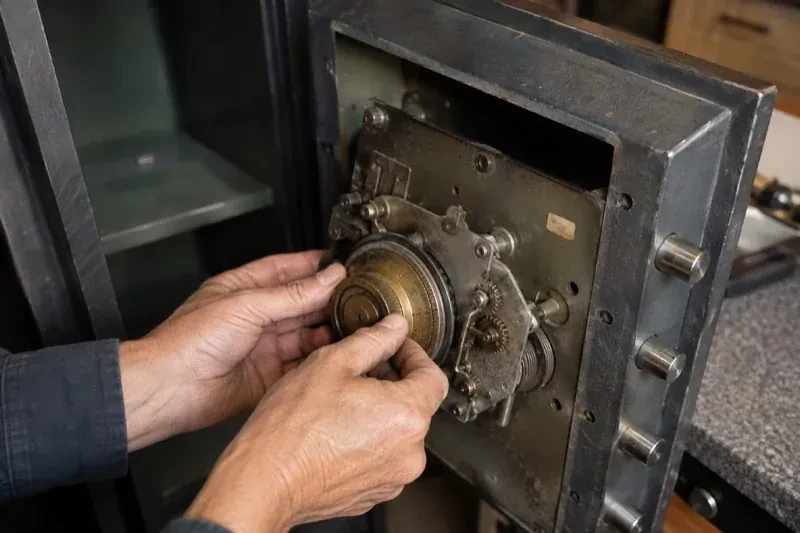
Many electronic locks support more than one user code, so a manager and one or more backup employees can each be set up separately during the same visit rather than sharing a single combination. A mechanical dial only holds one combination at a time, so multiple access there means agreeing who holds it and how that changes when staff do.
Can the combination or code be changed after installation?
Yes, on both mechanical and electronic locks. A mechanical dial is reset to a new combination by working inside the lock body, while an electronic keypad is simply reprogrammed at the keypad or through its service menu. Changing it after a change in staff, a move, or simply out of caution is routine work rather than anything unusual, and it can be arranged as its own visit.
Will my door look different afterwards?
Barely. A high security cylinder sits in the same place as the old one and is usually distinguished only by a different keyway shape and sometimes a hardened collar. A graded deadbolt is a standard-looking deadbolt in your chosen finish. The reinforced strike is longer than the plate it replaces and the wrap-around reinforcer, if used, shows as a neat metal band on the door edge. The difference is felt when you lock up, not seen from the street.
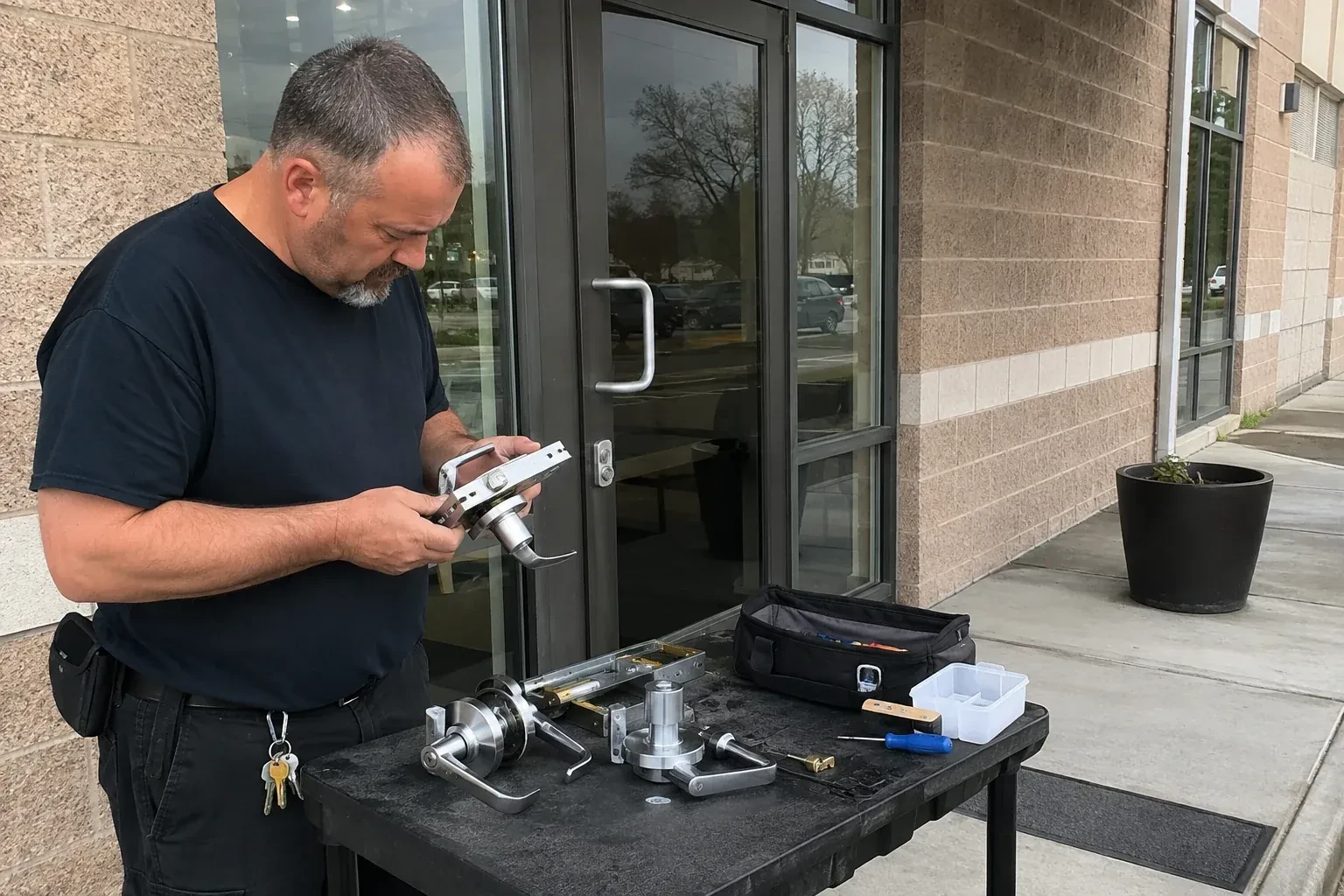
What happens with our fire exit doors and panic bars?
The outside cylinder on an exit door controls entry only, and it can be rekeyed like any other. The inside stays as it must: one push or one turn, no key, no special knowledge, on the exit door itself and on any door on the way to it. A locksmith will not add a keyed device to the inside of an exit, and will point out one if it already exists.
Can cleaners or contractors get limited access without a master key?
Yes. A change key or a narrow sub-master covering only the areas they service is the usual approach, rather than handing over a level that reaches further than the job requires. Where the property uses keypad or card access alongside mechanical keys, a time-limited or role-specific electronic credential can serve the same purpose without a physical key changing hands at all.
Does a door still need a mechanical key at all once it's on the system?
Not always — it depends on the hardware chosen for that door. Where a mechanical override cylinder is fitted and keyed in, it can still be opened by key regardless of what happens to the electronics, the network, or the power supply, and it is meant as a backup rather than a daily habit, since using it routinely bypasses the entry record the system is there to keep.
Is delayed-egress hardware allowed here?
Delayed-egress locking has a defined place in the codes that cover it, generally paired with sprinkler protection and a fire alarm system, and it is not a way to lock a door indefinitely; a short delay still releases on its own once the push is held, and always releases as soon as a fire alarm signal arrives. Whether it suits a given opening depends on the occupancy and the authority having jurisdiction, so it is confirmed with them before it is specified.
Do you match hardware to my building's existing key system?
Yes, that is usually the first decision made. The locksmith checks whether your doors already run on a master or grand-master system, an interchangeable-core setup, or a restricted keyway, and orders replacement cylinders that slot into whichever structure you want to keep or move to. Bringing a new door onto an existing system is generally simpler than starting that door on its own.
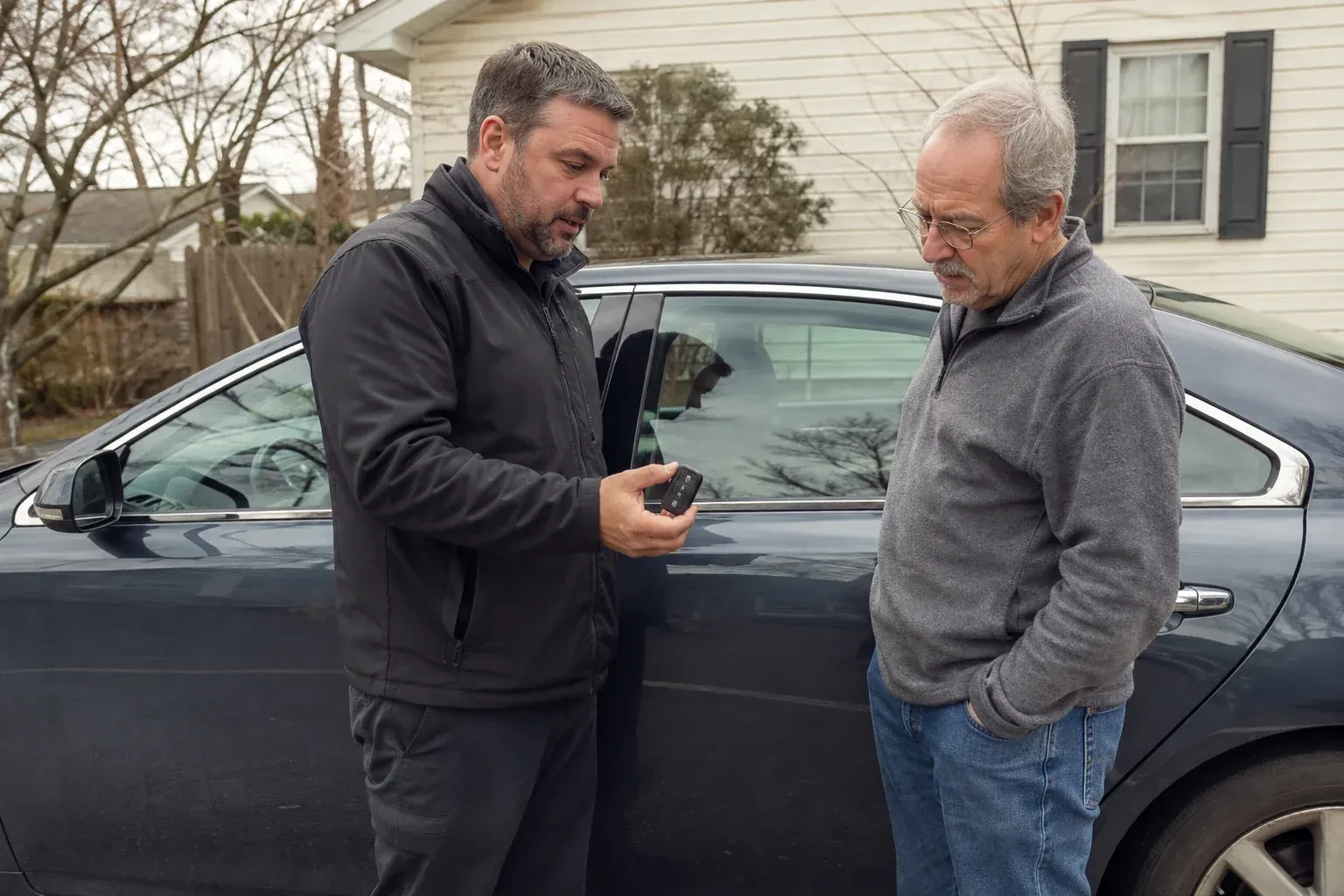
I have lost my only key. Can a locksmith make a new one at the roadside?
For most cars, yes. After the car is opened, the door cylinder is decoded to read the cuts, or the key code is drawn from the vehicle records against your proof of ownership, and a blade is cut in the van. A transponder key or fob is then programmed through the diagnostic port so the engine will start. Some newer or high-security models need dealer-only parts; you are told that up front rather than after.
What is the small metal blade inside my smart key for?
It is the emergency key. When the fob's battery is flat, or the car's own battery has died and the doors ignore the buttons, the blade unlocks the driver's door mechanically. A small release on the fob lets it slide out. On a replacement fob the locksmith cuts this blade to your door lock and shows you where the keyhole is, since on some cars it hides under a cap on the handle.
Is there a reason to make a spare now rather than waiting until the original is lost?
The whole process depends on having a working key to read or trace from, so making the spare while that key still exists is simpler than the alternative of proving ownership without any key present and building access from scratch. A spare made now also means a future lost key is solved by reaching for the second one already tested and waiting, rather than starting the whole process from nothing.
Can you tell me which fob to buy before you arrive?
Often, yes, once the vehicle's identification number, model year and trim are known, since those details narrow down which fob part is actually compatible. Buying the wrong part number is a common reason a programming attempt goes nowhere, so confirming compatibility before ordering saves a returned part and a second visit.
Does cold weather affect a key or its fob?
The metal blade and the passive chip inside it are not affected by cold. The fob's battery is a different story: cold weather reduces a battery's effective output, which can turn a marginally weak battery into one that suddenly stops responding on a cold morning. Testing a fob's battery before winter sets in catches this early.
How do you tell the cylinder apart from the switch behind it?
The cylinder is the part the key physically touches and turns; the switch is the electrical component behind it that responds to each position. The locksmith checks whether the barrel itself moves cleanly through every stop and whether the dash and starter respond at the right moments. When the barrel turns properly but the response is missing, the switch or wiring is a likely cause, though the battery, starter and park/neutral circuit are checked too before settling on it.
My key fob case is cracked. Does that need fixing too?
It is worth addressing, since a cracked case lets in moisture and dust that can reach the circuit board and buttons inside, shortening the fob's working life. A replacement shell or a full replacement fob, paired to the vehicle, resolves this alongside any battery or pairing issue.
My steering lock seized up over winter storage. Can that be fixed without a whole new lock?
Usually, yes. The cleaning method the lock's own maker directs, along with gentle, repeated working of the mechanism, frees many steering locks that have simply seized from disuse or corrosion, without needing to force the key or replace the lock. Only a lock that is cracked, badly rusted internally, or damaged by an earlier forced attempt tends to need full replacement rather than freeing and lubricating.